










Triple Dragon Funding Review Summary
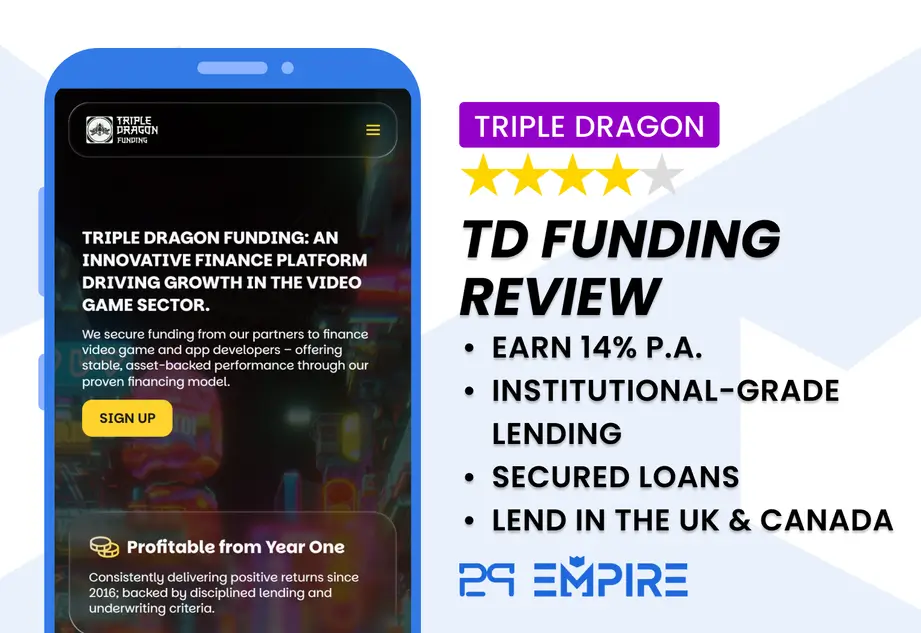
Triple Dragon Funding is a P2P platform backed by a loan originator with a nine-year track record and less than 1% bad debt. Investors earn up to 14% interest on loans secured by receivables and tax credits, with no cash drag and exposure to the UK, Canada, and the US.
This Triple Dragon Funding review covers the lending structure, collateral quality, regulatory status, liquidity, and key risks investors need to understand before committing capital.
Main Takeaways From Our Triple Dragon Funding Review
- Unique collateral structure: loans secured by tax credits and publisher receivables
- 14% interest rate with daily compounding
- No cash drag — large loan pipeline available
- Not yet regulated — operating under EU Prospectus Regulation exemption
Triple Dragon Funding offers up to 14% interest with an early exit option. It is a structurally different product from most platforms in the market.
Are you wondering how Triple Dragon Funding works? Watch this video right here:
Are you ready to increase your yields?
What Is TD Funding?
Triple Dragon Funding (tdfunding.eu) is a P2P lending platform registered in Luxembourg. It facilitates funding for Triple Dragon, a UK-based loan originator specialising in game development finance. The company funds developers through receivables, contracts, and government tax credits.
TD Funding offers up to 14% interest on two-year loans. The minimum investment is €1,000.
Pros
- Strong legal and security structure
- 14% interest rate with daily compounding
- Early exit option available
- Experienced management team
- Profitable loan originator with less than 1% bad debt over nine years
Cons
- High minimum investment: €1,000
- Not yet a regulated crowdfunding platform
Our Opinion
Triple Dragon Funding is not a typical fintech startup. The lending business behind the platform has been operating since 2016.
The platform itself is still in MVP stage, with minor bugs and unfinished elements. But the loan originator is not new — the team has structured, priced, and underwritten loans for almost nine years.
This is an established lending operation that has opened its strategy to external investors through a crowdlending structure.
The securitization and funding structure stand out. It is more robust than what most crowdlending platforms offer. Loans are repaid from tax credits or receivables — not from asset refinancing. This reduces refinancing risk compared to real estate or forestry-backed platforms.
The loan book supports this. Around 70% of borrowers are recurring clients. P2P investors have recorded no losses so far. The offer also includes no withholding tax and eligibility for legal entities — both unusual in this segment.
Geographic exposure is unusual in the crowdlending space. Around 95% of loans are linked to the UK, Canada, and the US — markets with reliable legal systems and established enforcement frameworks.
On the risk side, there is no instant exit. Liquidity needs to prove itself over time. The platform relies on a third-party software provider, which adds dependency risk. Financials are transparent but not yet audited.
The platform currently operates under a regulatory exemption. A formal application for a crowdfunding license is planned for Q2 2026. Approval may take up to 12 months.
There is no cash drag, a large loan pipeline, and a compounding feature that keeps funds invested at all times.
Management plans to double the loan book by end of 2026. We will monitor whether portfolio quality holds as the platform scales.
Overall, Triple Dragon Funding offers a structurally differentiated product for experienced investors. The risk-reward profile is competitive — but regulation and liquidity still need to be proven.
Where This Platform Fits
Triple Dragon Funding can be used to increase overall portfolio yield through exposure to niche, receivables-based lending. It should not be treated as a core holding due to its current regulatory status, limited track record on the platform level, and unproven liquidity.
What Can Go Wrong
- Liquidity may not work as expected, especially during periods of lower investor demand
- Recovery timelines can extend up to 18 months in worst-case scenarios
- The platform is not yet regulated under the ECSP framework
- Delays in tax credit payouts or receivables can impact cash flow timing
- Operational dependency on a third-party infrastructure provider
- Financials are not fully audited and rely on management reporting
Bonus & Promo Code
P2P Empire readers qualify for a 1% cashback bonus. All investments made within the first 60 days after registration are eligible.
The bonus is uncapped and calculated on the total invested amount. A €1,000 investment returns €10. A €10,000 investment returns €100.
Learn more about it on our Triple Dragon Funding bonus and promo code page.
Requirements
TD Funding is open to private investors with a European (EEA) bank account and to legal entities.
Registration requires email confirmation and identity verification. No suitability tests are required, which makes onboarding faster than on regulated Baltic platforms.
After verification, investors can top up their account via a Lithuanian payment institution. Deposits are typically credited within a few hours.
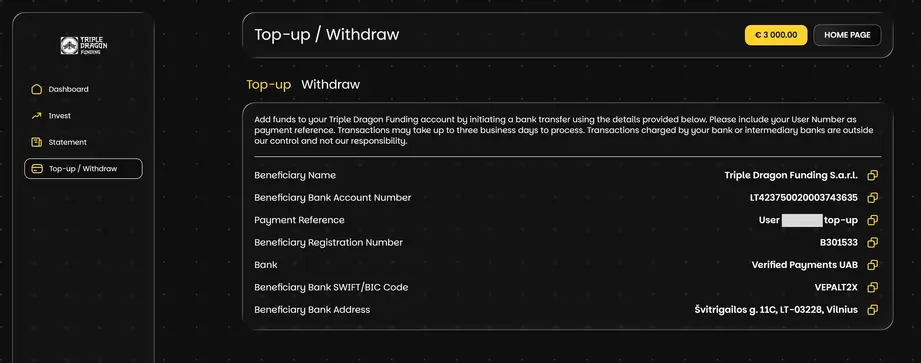
Top-up details are accessible in the left navigation under "Top up / Withdraw".
Risk & Return
Evaluate the risk relative to the return. For Triple Dragon Funding, the primary risk factor is the loan originator's track record and the due diligence on its founders.
We conducted an interview with the platform's CEO to assess the business model and the key risks investors face.
You can read a short summary of the Triple Dragon Funding CEO interview or watch the full interview with timestamps below.
What Is Triple Dragon?
Triple Dragon is a loan originator that works with game developers publishing on Steam, Google Play, the App Store, Xbox, PS5, and Nintendo Switch.
The loan originator charges an average annual interest fee of 24%, paid monthly. Loan terms range from 6 to 24 months. Loan sizes range from €100K to €5M.
Many developers prefer debt financing over equity dilution. Triple Dragon structures loans to align with their repayment capacity.
User Acquisition Finance
Triple Dragon can finance marketing and user acquisition for game developers. If the lifetime value of a customer exceeds the cost per install, the borrower can use additional funding to grow revenue without selling equity.
Cashflow Funding
For established studios developing a new title, Triple Dragon provides working capital. Receivables and government tax credits are used to repay the debt.
Triple Dragon ensures that revenues from app stores, platforms, and game distributors are used to repay loans before reaching the borrower's bank account.
Track Record
Triple Dragon started lending in December 2016. Since then, the loan originator has funded more than €50M in loans and paid out more than €7M in interest. Total write-offs since inception are under €500K.
As of January 2026, the outstanding portfolio stands at $28M USD (approximately €24M). 70% of clients are recurring borrowers.
Funding Sources
- Equity (retained earnings)
- Debitum Investments (regulated P2P platform)
- Wholesale facility in the UK (non-bank lender)
- Luxembourg securitisation with a single institutional investor (credit fund)
- TD Funding (TD platform) — new funding source
Financials for the Triple Dragon holding company are publicly accessible via Companies House.
Key performance indicators based on Q3 2025 results:
- Equity / Assets Ratio: 11.88%
- Debt / Equity Ratio: 7.36x
Using our P2P lender risk scale, these financials classify as moderate risk. In Q3 2025, Triple Dragon reported a net profit of $1.03M USD.
- Annual overviews are pro forma consolidated figures in USD, derived from management accounts and prepared for internal reporting only.
- The group is not required to produce audited consolidated accounts. Individual company statements are prepared by external accountants and may be revised.
- Figures are subject to reconciliation differences and FX translation adjustments.
- Overviews include income and assets from ring-fenced SPVs, which may carry distribution restrictions to the parent company.
Triple Dragon fully hedges its foreign exchange exposure. Reported negative FX results reflect accounting adjustments, not unhedged currency risk.
Geographic Exposure
Triple Dragon operates in markets with well-established legal systems. The current loan portfolio is concentrated in three jurisdictions:
- United Kingdom
- Canada
- United States
A small number of borrowers are based in EU countries such as Germany or Sweden. For non-UK borrowers, Triple Dragon may create a UK-based SPV and issue the loan to that entity. This keeps the legal framework and enforcement rules consistent.
There are no active loans in the Middle East. The Abu Dhabi entity exists only for future regional expansion and is not used for lending.
Lending to Game Developers Outside the UK
Triple Dragon only lends in markets it understands well. Local rules still matter — in Canada, for example, lending conditions vary by province.
To reduce risk:
- The team meets borrowers in person at international gaming conferences
- Relationships are built face-to-face
- Underwriting rules are adjusted based on borrower location and business model
The gaming industry is global. Borrowers often operate across borders, so geography alone does not define risk.
Collateral Requirements
All loans must be secured by collateral. The minimum collateral requirement is 120% of the outstanding loan amount. Higher collateral levels may apply depending on borrower risk, collateral type, and revenue stability.
Collateral Breakdown in the Current Loan Book
The loan portfolio is secured by different types of receivables. Current breakdown as of January 2026:
- Tax credits and grants: 39%
- Publisher and platform receivables: 48%
- Other receivables: 13%
- User acquisition (UA) receivables: 0%
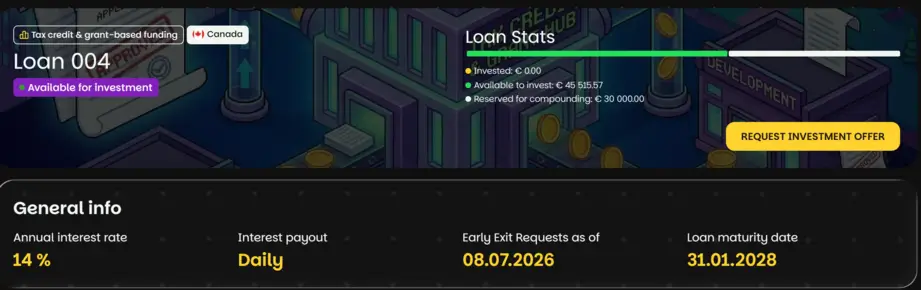
Collateral can be reviewed at the individual loan level. There are no major differences in collateral types by geography.
Loan Applications & Approval Rate
Triple Dragon does not publish detailed application statistics. During our research, we reviewed several borrowers directly. The loan originator confirmed that most applicants are rejected.
The main reasons for rejection are:
- Insufficient experience
- Weak or inadequate collateral
Rejection rates are consistent across regions.
Loan Recovery Process – Real Example
Triple Dragon has a low write-off rate. We requested a concrete description of how the loan originator recovers defaulted loans.
Reasons for Default
In 2023, widespread project cancellations in the gaming industry affected one borrower. This led to staff layoffs and the inability to continue loan repayments.
Triple Dragon initiated a recovery process that included:
- IP ring-fencing: The game was moved into a separate legal entity to protect the asset
- Asset preparation: Critical bug fixes were completed so the game could be reviewed by publishers
- Grant applications: The borrower applied for external funding from a games investment fund
- Phased repayment: Grant funds would first be used to repay the loan, with remaining funds supporting the game launch
Best-Case Recovery Scenario
- Recovery strategy: Successful grant funding
- Expected recovery: Up to 100% of the outstanding amount
- Expected timeframe: 2–3 months
Worst-Case Recovery Scenario
- Recovery strategy: Revenue from a mobile game version published by a third-party publisher
- Expected recovery: 25%–50% of principal
- Expected timeframe: Up to 18 months
Investors should factor in the worst-case scenario when assessing liquidity and capital preservation risk.
Corporate & SPV Structure
Each funding source operates through its own special purpose vehicle (SPV). Money, loans, and risks are legally separated across funding sources.
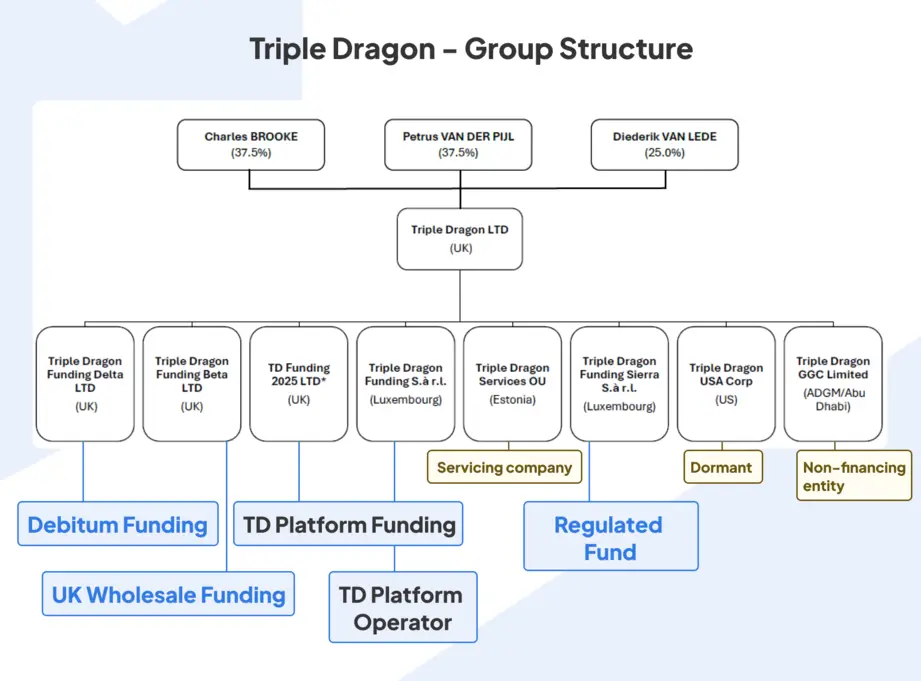
Each SPV holds its own security structure. Assets are not mixed across platforms or lenders.
For the TDF platform, security is registered at UK Companies House. This makes it publicly verifiable. The assets of the TDF platform are pledged to TD Funding 2025 Ltd. under a first-ranking debenture — the strongest form of security priority.
The debenture includes a negative pledge. The SPV cannot use the same assets as security for any other lender. Because the pledge is publicly visible, other funders are unlikely to lend against these assets — they would only receive second-ranking security.
This structure separates funding sources, protects investor claims, and prevents overlapping security interests.
Crowdfunding Regulation
As of today, Triple Dragon is not regulated under MiFID II or the ECSP framework. A license application is planned for the end of Q2 2026.
The licensing process may take up to 12 months. This would be the first CSP license issued in Luxembourg, so the timeline depends on the regulator.
In the meantime, the platform operates under an exemption in the EU Prospectus Regulation (Article 4(b)). Under this exemption, each investment offer is limited to 149 investors per EU member state.

This setup was confirmed by a legal opinion reviewed during our due diligence. The platform has not made it public to avoid providing a roadmap for competitors.
Buyback Obligation
Triple Dragon Funding includes a 90-day buyback obligation. It is provided by the underlying SPV, TD Funding 2025 Limited.
If a loan is more than 90 days past due, the SPV is responsible for buying it back from investors under defined conditions.
To support this obligation, Triple Dragon contributes its own assets to TD Funding 2025 Limited. The initial capital contribution is at least €3M and may increase to €5M over time. This provides an additional financial buffer for investors.
Platform Infrastructure Risk
The TD Funding platform's technical infrastructure is outsourced to White Label Solutions, owned by SIA WIN WIN INVESTMENTS.
The same system is used by other platforms, including Ventus Energy, Devon, and Asterra Estate. This creates two risks for investors: potential data access by third-party employees, and reputational contagion if another platform on the same system fails.
According to Triple Dragon, there is no ownership overlap or conflict of interest between the software provider and the loan originator. The platform owns all data, stored in the cloud alongside a copy of the platform's code.
Further Risks
Some risks are outside the platform's control. These include delays in tax credit payouts or payments under co-development contracts. Default risk from underlying debtors — such as app stores, platforms, and game publishers — is also present.
Reliance on New Investor Funding
Triple Dragon's business model does not depend on continuous new investor inflows. If new funding slows or stops, the loan originator continues collecting repayments from existing loans. These cash flows are used to repay investors in full.
The interest charged to borrowers exceeds the interest paid to investors and other funding sources. This margin is sufficient to service all obligations without relying on new capital.
New loans are funded primarily from retained profits, supporting organic portfolio growth.
Returns
Investors earn 14% per year on loans secured by tax credits, receivables, and contractual payment rights. These collateral mechanisms have been refined over the past nine years by the loan originator.
Is TD Funding Safe?
This section covers the platform's team, shareholders, and CEO — key factors when evaluating whether TD Funding is a trustworthy platform.
Who Owns the Platform?
TD Funding is owned by Triple Dragon Limited, incorporated in December 2016 and held by three shareholders.
- Pieter van der Pijl — Co-founder responsible for sourcing, analysing, and structuring gaming finance deals. Background in cross-border M&A and finance transactions.
- Diederik van Lede — Corporate lawyer based between London and Brussels. Has advised on M&A transactions worth several billion euros, spanning Europe, the Americas, Asia, and Africa. Serves as non-executive director on several international company boards.
- Charles Brooke — 18 years of experience in finance. Background in private equity with a focus on real estate. Active investor in fintech, video games, and educational software. Founded Warwick Capital in 2015 and co-founded Triple Dragon in January 2017.
Our research found no controversies or misconduct linked to any of the owners.
Who Operates the Platform?
The platform is run by an experienced team. Most staff have worked with Triple Dragon for multiple years.
- Vitalijs Zalovs — CEO. Joined Triple Dragon in 2025. Former CEO at Esketit.
- Jozua Laudams — Head of Portfolio Management. Joined October 2023.
- Ritesh Thadani — Head of Business Development. Joined February 2022.
- Kaloyan Dimitrov — CFO. Joined 2019.
Are There Any Suspicious Terms and Conditions?
We reviewed the terms and conditions during our onboarding process and requested clarifications on three clauses.
TOU 15.2: Why Are Accounts Terminated After Three Months of Inactivity?
Investor deposits are treated as advance payments for claim rights — not as held deposits. Uninvested funds are returned after three months. This avoids regulatory scrutiny and limits KYC/AML costs for inactive accounts.
TOU 21.1.2: Purpose of This Clause
This clause applies only in cases of suspected fraud — for example, when the verified investor appears to act on behalf of someone else. In past cases, accounts were managed by individuals other than the verified person. In such situations, in-person verification is arranged, with travel costs covered by the platform.
TOU 30: Notification of Changes to the T&C
Changes to the Terms of Use are not retroactive and do not affect existing user rights. Users are notified at least 30 days in advance. Immediate changes may occur if required by law — for example, to comply with updated KYC or AML regulations.
We found no anomalies or concerning clauses in the legal documents. Terms may change over time, so review the latest version before investing.
Conflict of Interest
Some SPVs — such as A One Games — serve only operational purposes: managing bank accounts and handling invoice collection. They generate no profit for Triple Dragon or TDF and create no financial conflict of interest.
In some cases, Triple Dragon may receive equity options, equity kickers, or revenue-sharing rights linked to a game. These are disclosed on the platform when they occur.

Equity kickers typically sit with the originating entity, TD Funding 2025 Ltd. This means they form part of the overall security available to investors.
Usability
Triple Dragon Funding has no auto-invest feature. Investors select loans manually under the "Invest" menu in the left navigation.
To invest, click "Request investment offer." This step is required to comply with the regulatory exemption described earlier.

In the next step, confirm your investment acknowledgement and click "Continue."
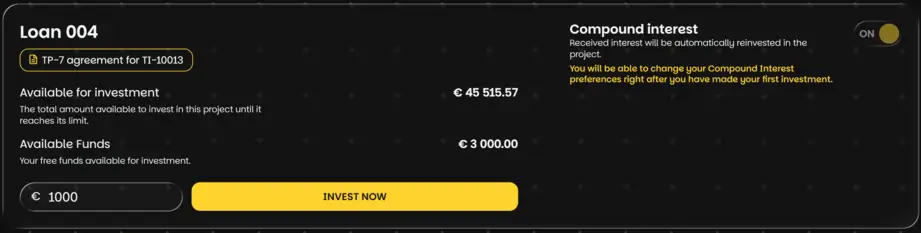
Enter your investment amount (minimum €1,000), review the loan agreement, and activate or deactivate the compound interest feature.

In the final step, enter your PIN code to confirm the investment.
After investing, all positions are visible in the investor dashboard under the "My portfolio" tab.
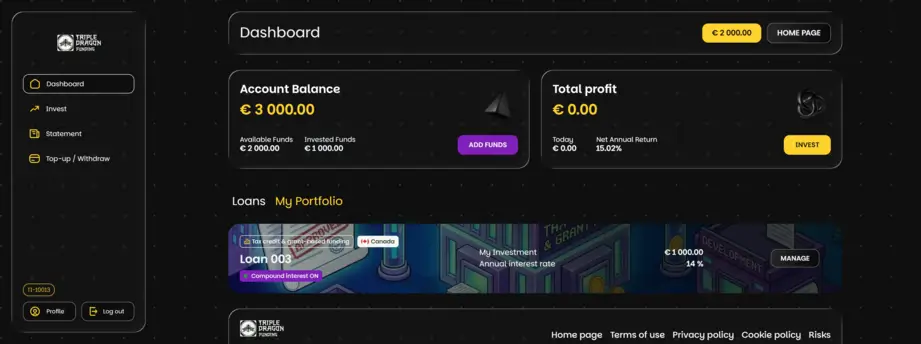
Compound Interest
The compound interest feature automatically reinvests daily interest into the same loan. This eliminates uninvested funds sitting idle in the investor account.
To disable it, navigate to your portfolio, select the relevant loan, and deactivate the feature. This can be done at any time after investing.
Liquidity & Secondary Market
Triple Dragon Funding offers an early exit feature. Investors can list loans on the secondary market after a minimum holding period of six months.

Once listed, other investors can purchase the loan in full or in parts, depending on available demand.
The secondary market is not yet fully operational. Real-world liquidity and exit reliability cannot be assessed at this stage. Investors should assume a minimum holding period of six months.
Most loans carry a two-year maturity. Investors should treat this as the base-case holding period.
Support
During this review, we were in regular contact with CEO Vitalijs Zalovs — often daily. Response times were typically within a few hours. Communication at the management level is reliable and efficient.
Standard platform support should not be assumed to offer the same response times. General inquiries can be sent to info@tdfunding.eu.
Alternatives
TD Funding is newly launched and currently operates without regulatory oversight. Investors who prefer regulated platforms with longer track records may find the following alternatives more suitable.
Indemo
Indemo is a Latvia-based, regulated investment platform focused on discounted, mortgage-backed loans from Spain. The platform targets a minimum return of 15.1% per year.
These are recovery-focused investments. Both interest and principal are typically received only after the recovery process is completed — an expected horizon of around two years. You can learn more in our in-depth Indemo review.
LANDE
LANDE is a regulated crowdfunding platform specialising in agricultural loans from Latvia, Lithuania, and Romania. A well-diversified LANDE portfolio targets average returns of 10%–11% per year. A secondary market is available for early exits. Further details are available in our LANDE review.
Nectaro
Nectaro is a regulated Latvian P2P lending platform offering investments in loans from Moldova, Romania, and the Philippines. Yields typically range between 12% and 14.5% per year. There is no secondary market, but most credit lines are short-term and repaid within approximately one year. You can find a full breakdown in our Nectaro review.